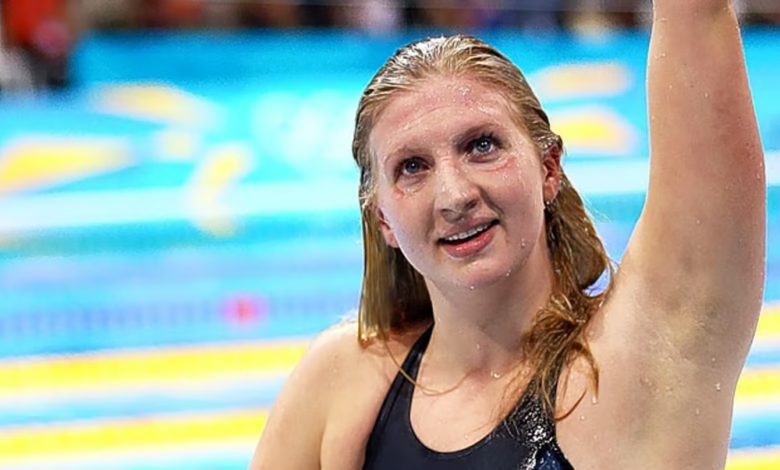
Who Is Rebecca Adlington?
Rebecca Adlington is a former British competitive swimmer, Olympic champion, broadcaster, and swimming advocate. She became one of the most recognizable names in British sport after her unforgettable performances at the Beijing 2008 Olympic Games, where she won two gold medals in freestyle swimming. Her success made her a national hero and helped bring fresh attention to swimming in the United Kingdom.
What makes Rebecca Adlington’s story so powerful is not only the medals, but the way she won them. She was not presented as a loud celebrity athlete or a manufactured sporting brand. She came across as focused, grounded, emotional, and deeply committed to the sport. That natural personality made people connect with her very quickly.
Today, Rebecca Adlington is still strongly linked with swimming, even after retiring from competition. She works in media, supports swimming education, and remains a familiar voice around major aquatic events. Her career shows how an athlete can move from elite competition into a wider role that inspires children, parents, and sports fans.
Early Life and Start in Swimming
Rebecca Adlington was born in Mansfield, Nottinghamshire, and grew up in a family where swimming was already part of daily life. According to the International Swimming Hall of Fame, she was the youngest of three girls, and her older sisters’ involvement in swimming helped pull her toward the pool at a young age.
Her journey became more serious when she started showing promise as a distance swimmer. By her teenage years, she was training under coach Bill Furniss, who remained an important figure throughout her career. That long coach-athlete relationship gave her stability, structure, and the technical base needed to compete at the highest level.
Like many elite athletes, Adlington’s rise was not perfectly smooth. She dealt with physical and emotional challenges before becoming an Olympic star, including illness and difficult family circumstances. Those experiences did not stop her progress. Instead, they shaped the resilience that later became one of her biggest strengths in the pool.
The Beijing 2008 Breakthrough

Beijing 2008 changed everything for Rebecca Adlington. She arrived as a talented British swimmer, but she left as a double Olympic champion. Her first gold came in the 400m freestyle, a race where she produced a brilliant late surge to beat the field in dramatic fashion.
That victory was already historic because it was the first Olympic swimming gold for a British woman since Anita Lonsbrough in 1960. For British swimming fans, it felt like a huge moment. Adlington had not only won a race; she had broken a long wait and reminded the country that British swimmers could win on the biggest stage.
Then came the 800m freestyle, her signature event. Adlington dominated the final and broke Janet Evans’ 19-year-old world record. Winning one Olympic gold can define a career, but winning two in the same Games placed her in a different category. She became the first British swimmer since Henry Taylor in 1908 to win multiple Olympic gold medals at one Games.
Success After Beijing and London 2012
After Beijing, Rebecca Adlington carried the pressure that comes with being an Olympic champion. Suddenly, every race mattered more, every result was analyzed, and every major competition came with public expectation. That is not easy for any athlete, especially one still young and developing.
She continued to prove her quality between Olympic cycles. At the 2011 World Championships, she won gold in the 800m freestyle and silver in the 400m freestyle, showing that Beijing was not a lucky peak. She remained one of the world’s leading distance freestyle swimmers.
At the London 2012 Olympics, Adlington added two bronze medals in the 400m and 800m freestyle events. Competing at a home Olympics brings a special kind of pressure, and she still reached the podium twice. That achievement gave her four Olympic medals overall and confirmed her place among Britain’s greatest swimmers.
Retirement and Life Beyond Competition
Rebecca Adlington retired from competitive swimming at the age of 23. That may sound young to casual sports fans, but elite swimming demands years of intense training, discipline, and sacrifice. By that point, she had already achieved what most athletes spend a lifetime chasing.
Her retirement did not mean she disappeared from public life. She moved into media work and became known as a swimming commentator and pundit, especially during major events. The International Swimming Hall of Fame notes that she joined the BBC as a commentator for aquatic sports after retirement.
This second chapter suited her well because she understands swimming from the inside. She can explain race tactics, pressure, pacing, and athlete emotions in a way that feels clear and honest. That makes her valuable not just as a former champion, but as someone who helps viewers understand the sport better.
Rebecca Adlington’s SwimStars and Swimming Advocacy
One of Rebecca Adlington’s most meaningful post-retirement projects is her work in children’s swimming. Becky Adlington’s SwimStars was launched in 2016 and focuses on helping children learn to swim with confidence, strong technique, and water-safety awareness.
The programme is designed for children aged 3 to 11 and puts emphasis on fun, safety, and steady progress. Its official site explains that lessons are divided by ability groups, including Foundation, Early Swimmer, Improver, and Advanced, so children can learn with others at a similar level.
This work matters because swimming is not just a sport. It is also a life skill. Adlington’s mission connects her Olympic background with a practical public purpose: helping more children feel safe and capable in the water. That is a strong legacy because it reaches beyond medals and into everyday family life.
Why Rebecca Adlington Still Matters
Rebecca Adlington still matters because her story represents a rare mix of achievement, personality, and long-term impact. She gave Britain two unforgettable Olympic gold medals, but she also showed the emotional side of elite sport. Fans saw her joy, pressure, disappointment, honesty, and determination.
Her influence is especially important for young swimmers. She proved that someone from a normal British background could reach the very top of world sport through discipline, coaching, and mental strength. That message continues to inspire children who enter swimming lessons with big dreams or simple goals.
She also helped raise the profile of women’s sport in the UK. Her Beijing 2008 success came before the current boom in visibility for female athletes, so her achievements played a part in changing the conversation. She became a role model without needing to force the image.
Conclusion
Rebecca Adlington’s career is one of the most impressive stories in modern British swimming. From her early days in Mansfield to Olympic glory in Beijing and more medals in London, she built a record that still earns respect. Her four Olympic medals tell only part of the story.
Her real legacy is broader than race results. She helped British swimming believe bigger, gave fans unforgettable Olympic memories, and used her platform to support swimming education. That makes her more than a former champion.
Also Read:Stacey Solomon